2026 Best Laser Thermometer Buying Guide for Global Buyers
Choosing the right Laser Thermometer in 2026 requires more than comparing prices and temperature ranges. Global buyers must examine accuracy, emissivity settings, measurement distance, response time, and operating conditions. A device that performs well in a clean laboratory may struggle near steam, polished metal, sunlight, or moving machinery. The red laser only marks the target. It does not measure temperature.
Professor Michael Vollmer, a recognized infrared thermography researcher, explains, “Emissivity is one of the most important parameters in non-contact temperature measurement.” This practical warning deserves attention. Shiny stainless steel can reflect nearby heat and produce a misleading reading. A user may see 180°C on the display, while the actual surface is much cooler. Small details matter.
This guide helps international purchasers compare professional and general-purpose models with greater confidence. It considers calibration documentation, CE or other market-appropriate compliance information, battery availability, screen readability, and protection against dust or moisture. Industrial users should also check the distance-to-spot ratio before ordering. A narrow target needs a better optical design.
The perfect instrument does not exist. That is worth admitting. Even an advanced Laser Thermometer can produce errors when the surface, angle, or environment changes. Buyers should test real materials before committing to large quantities. They should also review supplier support, warranty terms, and service access in their region. Reliable temperature control begins with honest measurement limits, not impressive packaging.
What a Laser Thermometer Is and How It Measures Temperature
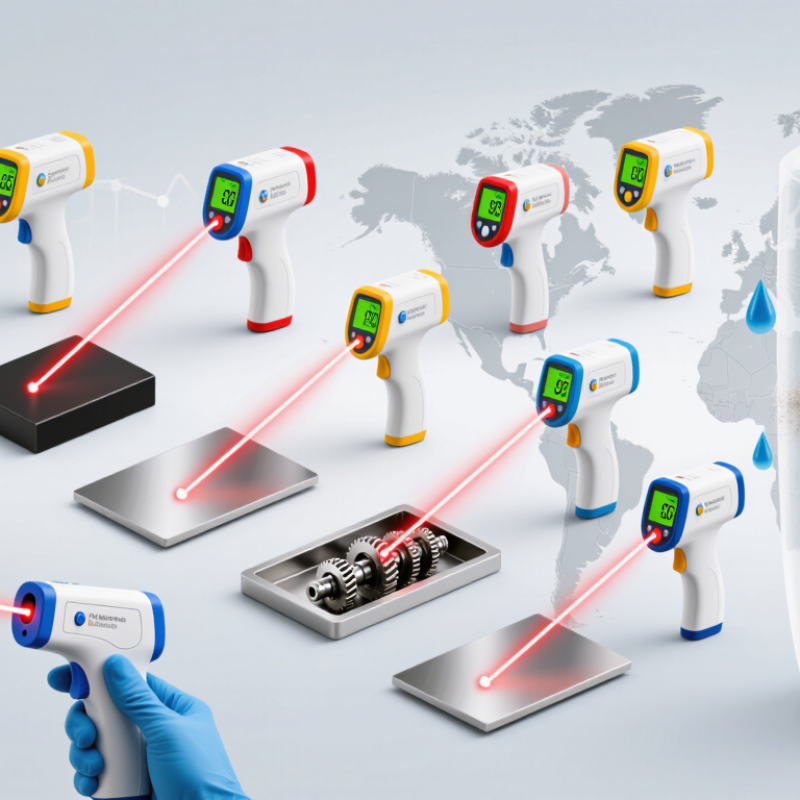
A laser thermometer, more accurately called an infrared thermometer, measures surface temperature without touching the object. Its laser only marks the target area. The infrared sensor detects thermal radiation from that surface and converts it into a temperature reading. Hotter objects usually emit more infrared energy. The device interprets that energy through an internal calibration system.
During a kitchen inspection, the reading may change when the thermometer moves farther away. Every model has a distance-to-spot ratio. A ratio of 12:1 can measure a 10-centimeter area from 120 centimeters away. Aim at the center, not the edge.
Shiny metal, glass, and wet surfaces can reflect nearby heat and produce misleading results. Matte tape often gives a more stable reading on reflective equipment. Small targets need careful positioning.
Emissivity matters. It describes how efficiently a surface emits infrared energy. Most painted or nonmetal surfaces are easier to measure. I still compare uncertain readings with a contact probe, because one infrared reading can feel convincing and remain wrong. Dust on the lens, steam, airflow, and sudden temperature changes can also affect accuracy. Let the instrument adjust to the room before testing. Keep the sensor window clean. A laser thermometer is fast and practical, but it measures surfaces, not internal temperature.
Key Features That Define Laser Thermometer Performance
For global buyers, a laser thermometer should be judged by measurement behavior, not a bright plastic case. Its infrared sensor reads thermal radiation, while the laser only helps aim. Accuracy depends on emissivity, surface texture, distance, and ambient temperature. A model with adjustable emissivity handles painted metal, rubber, and food surfaces better. Check the stated accuracy range, not just the best number. In field testing, shiny stainless steel often gives misleading readings. That is easy to overlook.
Distance-to-spot ratio Distance-to-spot ratio is a practical performance feature. A 12:1 ratio means the thermometer measures a one-inch area from twelve inches away. Choose a tighter spot for electrical panels or small machine bearings. Response time matters when temperatures change quickly. A stable display, backlight, and visible alarm reduce reading errors in dim workshops. Look for a calibration statement, operating temperature range, and protection rating. Battery life also matters during inspections. Still, no instrument stays perfect forever; periodic verification against a trusted reference is wise.
Tips: Hold the sensor at the correct angle and avoid steam, dust, or glass between it and the target. Let the device adapt to room temperature before demanding precision. Compare repeated readings from the same spot. If results jump, investigate the surface before blaming the thermometer. Record emissivity settings with each inspection. This small habit improves traceability, although busy teams may forget it.
Global Standards, Safety Requirements, and Regional Considerations
2026 Best Laser Thermometer Buying Guide for Global Buyers
A laser thermometer is an infrared sensor with a visual aiming beam. The beam does not measure temperature. It only shows the target area. ASTM E1965 and ISO 80601-2-56 provide useful benchmarks for infrared temperature performance. Buyers should check stated accuracy, calibration conditions, emissivity settings, and distance-to-spot ratio. A small sensor can read a whole pipe from far away, but its measurement area may become too large.
Laser safety varies by product design and market. IEC 60825-1 classifies visible laser products, with Class 2 devices generally limited to 1 mW output. The label should show the class, wavelength, warning symbol, and operating instructions. Avoid aiming at eyes, aircraft, vehicles, or reflective metal. Simple advice. Still often ignored.
Regional compliance needs closer attention. European shipments may require CE documentation, EMC testing, and RoHS evidence. Wireless models can also require radio approvals. In the United States, buyers should review FCC requirements and applicable product rules. Other regions may reference national versions of IEC standards. Supplier quality matters too: the ISO Survey 2023 recorded more than 1.2 million ISO 9001 certificates worldwide, but certification alone proves little about measurement accuracy. Request a recent calibration report, test uncertainty, and traceability details. I would not trust a dramatic “±0.1°C” claim without test conditions. Reflective surfaces, steam, dust, and cold drafts can distort readings. That is the weak point.
2026 Best Laser Thermometer Buying Guide: Regional Mains Voltage Reference
This chart shows nominal household voltage by major buying region. Laser thermometers are commonly battery-powered, but the voltage and frequency requirements of chargers, docking stations, and wired accessories must match the destination market.
Reference values: North America 120 V / 60 Hz; European Union, United Kingdom, China, and Australia 230 V / 50 Hz; Japan 100 V / 50 or 60 Hz depending on area. Buyers should also verify IEC 60825-1 laser safety classification, applicable electromagnetic-compatibility requirements, plug type, and local conformity rules before purchase.